Washing machine hose burst from high water pressure in Bellevue: emergency steps, hose upgrade, and the permanent fix
Rubber washing machine hoses rated to 150 PSI fail when static water pressure exceeds 80 PSI — the normal operating limit — because pressure cycling from water hammer and thermal changes fatigues the rubber over time. In Bellevue's hillside neighborhoods (Somerset, Newport Hills, Lakemont), city main pressure frequently exceeds 100–115 PSI before the PRV, and homes with failed or absent PRVs operate well above the safe range for standard rubber hoses. A burst washing machine hose releases 4–8 gallons per minute directly onto the laundry room floor with no automatic shutoff — it is one of the most destructive appliance failures in terms of water volume per event. This guide covers the emergency steps, how to confirm high pressure is the cause, the upgrade to braided stainless hoses, and the permanent fix through PRV installation.
Last reviewed: 2026-06-16
Why do washing machine hoses burst from high water pressure?
Standard rubber washing machine hoses are rated to 150 PSI static burst pressure, but the safe operating range is 40–80 PSI. Bellevue homes on hillside lots with failed or absent PRVs frequently see 90–120 PSI — within 30–60 PSI of the burst rating — and pressure cycling from water hammer fatigues the rubber at the fittings faster than the static rating implies.
The burst is almost never caused by a single pressure event. It is a fatigue failure: the hose is pressurized and depressurized hundreds of times per week as the washing machine inlet valve opens and closes. Each cycle slightly deforms the rubber at the metal fitting collar, the weakest point. Over 5–10 years of this cycling at elevated pressure (90+ PSI), the rubber cracks at the fitting-to-hose junction and the hose fails catastrophically.
Homes in Bellevue's hillside neighborhoods are at elevated risk for two reasons: (1) city main pressure arriving at the house exceeds 80 PSI before any PRV, and (2) aging PRVs from the 1980s and 1990s construction era have lost their regulation function, allowing street pressure to pass through unchecked. A PRV that was set to 65 PSI in 1990 and has never been serviced often passes 95–110 PSI through to every fixture and appliance in the house.
A standard rubber hose that is 5+ years old in a Bellevue home above 300 feet elevation is at meaningful failure risk. The hose looks intact from the outside until the moment it fails — there is no visible pre-failure indicator. Hose replacement on a schedule is cheaper than a burst event, which releases 4–8 gallons per minute onto the floor for however long it takes to be discovered.
Emergency steps when a washing machine hose bursts
Turn off the washing machine supply shutoffs immediately — the two valves directly behind the machine on the wall. If they are absent or stuck, close the main house shutoff. Then turn off the washing machine and call for water damage and plumbing service.
Step 1 — Reach behind the washing machine and close the two individual supply shutoffs: one for hot, one for cold. These are typically gate valves or ball valves on the wall directly behind the machine. Turn clockwise to close. If the valves are frozen with age or non-existent (some older Bellevue homes installed washing machines without individual shutoffs), close the main house shutoff.
Step 2 — Turn off the washing machine power. The machine may continue trying to run its cycle while the supply is gone, which can overheat the pump motor. Press the power button or unplug the machine.
Step 3 — Begin water extraction from the floor. A shop vacuum removes standing water faster than mops. Every minute of standing water on a wood subfloor increases saturation and damage. Remove baseboard trim along wet walls immediately — trapped moisture behind baseboard is one of the most common sources of laundry-room mold after a burst hose event.
Step 4 — Call for water pressure repair and PRV replacement in Bellevue to assess whether high pressure caused the burst, replace the hose, and check the PRV. Confirm the floor drying scope with a water damage restoration company if the water reached drywall or the subfloor.
How to check if high water pressure caused the hose burst
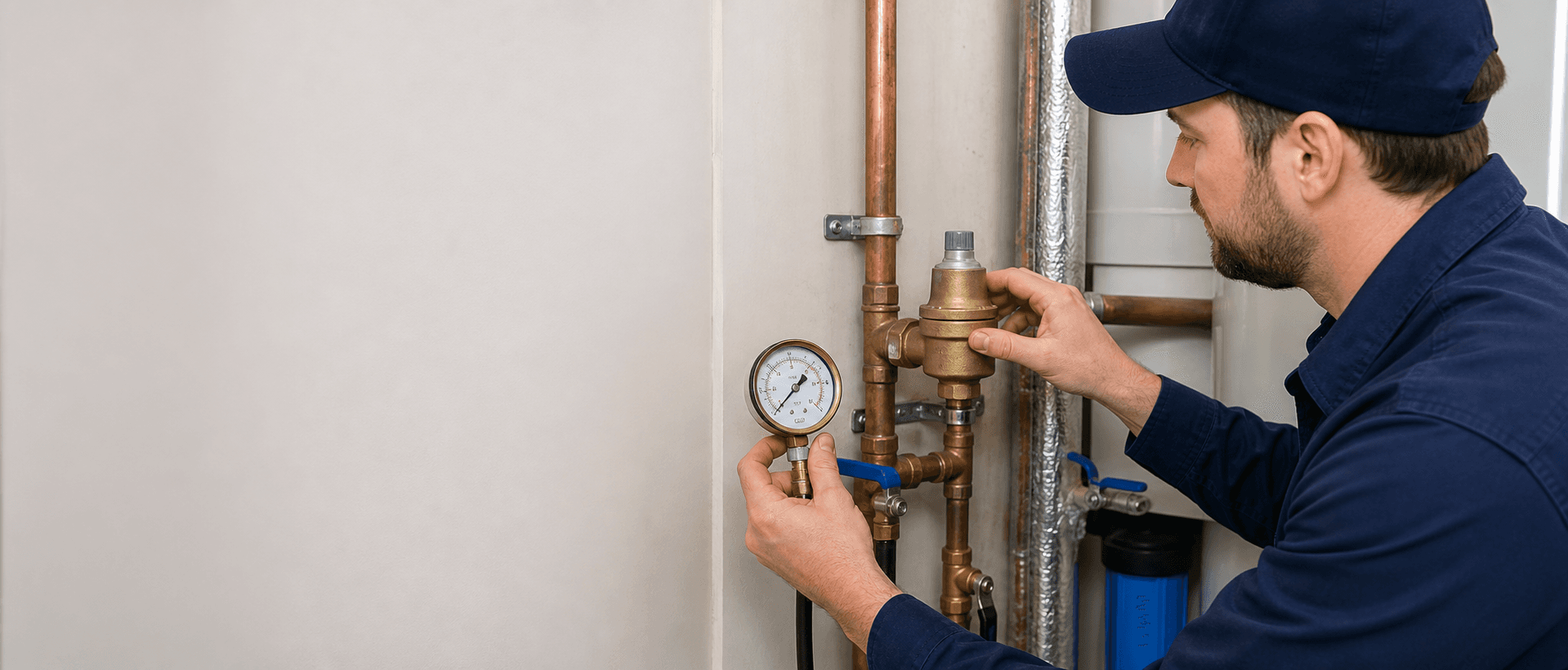
Attach a pressure gauge to the laundry room hose bib or a washing machine shutoff. A reading above 80 PSI with no fixtures running confirms high static pressure. Any reading above 80 PSI requires PRV installation or adjustment.
Pressure gauges are available at hardware stores for $15–$30. Attach the gauge to the laundry room hose bib and read the static pressure with all fixtures off. The Uniform Plumbing Code maximum for residential plumbing is 80 PSI; anything above that requires a PRV to be installed under Washington State code.
Test at two times: first thing in the morning before any water use (when street pressure is highest and domestic demand is lowest) and in the afternoon during normal household use. Morning pressure is typically 5–15 PSI higher than afternoon pressure. A morning reading of 95 PSI confirms that the plumbing system regularly operates at 15 PSI over code maximum.
Also check for water hammer — the banging sound in pipes when the washing machine inlet valve closes abruptly. Water hammer is a pressure wave caused by rapid valve closure, and its peak pressure reaches 2–3x the static pressure. A 70 PSI static system with water hammer produces 140–210 PSI at the washing machine inlet valve at the moment of closure — well above the hose's burst rating. Water hammer arrestors installed at the washing machine supply connections absorb this pressure wave and are a complement to PRV installation, not a substitute.
Which Bellevue neighborhoods see the most washing machine hose failures
Somerset, Newport Hills, and Lakemont have the highest rates of washing machine hose and supply line failures — all three are hillside neighborhoods with city main pressure above 80 PSI before the PRV and a significant number of homes with original 1980s–2000s PRVs now past their service life.
Somerset sits above 400 feet elevation in some sections. City main pressure at street level in Somerset frequently runs 95–110 PSI — meaning a PRV doing its job reduces this to 60–70 PSI, but a PRV that has lost regulation passes the full 95–110 PSI into the house. Somerset homes built in the 1980s are now on their second or third decade with original PRVs, many of which were last serviced never.
Lakemont's Cougar Mountain slope creates the steepest pressure differential on the Eastside — upper addresses see 110–120 PSI from the city main before PRV. The expansion tank requirements that come with PRV installation are also frequently missing in these homes, compounding the pressure cycling effect on appliance hoses.
Newport Hills, at 300–380 feet elevation in most sections, sees similar pressure profiles to Somerset. Homes in the lower-elevation sections of Newport Hills may be close to the 80 PSI threshold rather than well above it, but a failing PRV pushes them over. Any Newport Hills or Somerset home that has never had a PRV inspection should have pressure checked at the hose bib as a baseline.
Braided stainless vs. rubber washing machine hose: which survives longer at high pressure
Braided stainless steel hoses outlast rubber hoses by 3–5x at elevated pressure. Stainless braid hoses are rated to 400–800 PSI burst pressure vs. 150 PSI for rubber, and the steel braid prevents the fatigue cracking at the fitting collar that kills rubber hoses.
A braided stainless hose consists of a rubber inner core wrapped in a woven steel mesh jacket. The steel mesh resists the radial expansion forces that fatigue rubber hoses at the fitting collars, and the higher burst rating provides a much larger margin above Bellevue's street pressure levels. Quality braided stainless hoses (Fluidmaster, Watts, Eastman) are rated to 400+ PSI burst and carry 5-year warranties against failure.
Braided stainless hoses cost $12–$25 per hose (two needed: one hot, one cold) vs. $5–$10 for rubber. The upgrade cost is $15–$30 for a pair — typically returned by avoiding a single burst event. Replace both hoses at the same time regardless of which one fails; both are the same age and the same failure risk.
Even braided stainless hoses have a service life. Replace them every 8–10 years, or whenever you change the washing machine, or whenever the PRV is replaced. A fresh PRV that corrects high pressure combined with new braided stainless hoses is the complete low-cost preventive package. For the source of the pressure problem itself, see the water pressure regulator guide.
The permanent fix: PRV installation and what it protects beyond the washing machine
A pressure-reducing valve installed on the water service line where it enters the house brings all household pressure to 60–70 PSI, protecting the washing machine hose, the dishwasher inlet valve, the refrigerator icemaker line, toilet supply stops, and the water heater tank from chronic over-pressure.
A PRV is a single device installed at the point where the water service line enters the house — typically near the main shutoff valve. It reduces incoming street pressure (which may run 90–120 PSI in hillside Bellevue neighborhoods) to a set working pressure of 60–70 PSI. Everything downstream operates at the set pressure, regardless of what the street pressure does.
The appliances and fittings protected by a PRV: washing machine inlet hoses and valves, dishwasher supply hose, refrigerator icemaker supply line, toilet supply stops, shower cartridges and valves, and the water heater tank itself. High pressure is the single most common cause of premature appliance and fixture failure — a PRV is preventive maintenance for the entire plumbing system, not just the washing machine.
PRV installation in Bellevue runs $350–$650 installed, including the PRV, connection fittings, and an expansion tank if a closed system is created. Water pressure repair and PRV replacement in Bellevue is a same-day repair in most cases. The PRV pays back its cost by extending the life of every pressure-sensitive appliance in the house.
Sources
Every fact in this guide cites a verifiable public source. If you find a number we got wrong, email dispatch@bellevueplumberpro.com.
- Uniform Plumbing Code — Water pressure requirements (UPC 608)
- Insurance Institute for Business and Home Safety — Washing machine water damage prevention
- Insurance Information Institute — Preventing water damage in the home
- Washington State plumbing code (WAC 51-56) — Water pressure limits
Need help with this in your home? See our water pressure repair and PRV replacement in Bellevue page for pricing, our diagnostic process, and how same-day service works across the Eastside.
We dispatch for this across Somerset, Newport Hills, Lakemont, and Eastgate — see your neighborhood page for local response times and recent jobs.
Related services: Leak Detection and Pipe Repair.
Related guides
- Water hammer: why pipes bang and how to stop the noise
- Water pressure regulator (PRV): what it does, code, settings, and cost in Bellevue
- Low water pressure in the whole house: causes, testing, and fixes in Bellevue
- No water pressure in the shower: clogged head, restrictor, or cartridge
- Water pressure too high in your Bellevue home: signs, damage, and the fix
- Water heater expansion tank in Bellevue: why a PRV makes one required by code, cost, and signs it has failed