What temperature should a water heater be set to?
120°F — the temperature the U.S. Department of Energy recommends to balance scald safety and energy cost.
The recommended water-heater temperature is 120°F, which the U.S. Department of Energy sets to balance scald risk against energy use. Raising the setting toward 140°F controls Legionella but introduces a real scald hazard, so it should be paired with a thermostatic mixing valve that tempers delivery back to about 120°F at the fixtures. The two hazards genuinely pull in opposite directions — hotter water burns faster but kills bacteria, cooler water is safe to touch but lets bacteria grow — which is why the right setting depends on who lives in the house. This guide lays out the scald-time and energy figures, the Legionella growth and kill temperatures from the CDC and OSHA, the mixing-valve approach that resolves the conflict, and the step-by-step method to set and verify the temperature. It also covers why a moderate 120°F setting slows corrosion and helps the many aging Eastside tanks reach the upper end of their service life.
Last reviewed: 2026-06-04
Set a residential water heater to 120°F — the temperature the U.S. Department of Energy recommends to balance scald safety and energy cost.
The U.S. Department of Energy recommends 120°F as the default residential setting because it sits at the balance point between two competing costs: scald injury and wasted energy. At 140°F — where many factory-set tanks ship — the water is hot enough to cause severe burns quickly and the higher stored temperature loses more heat to standby and demand losses around the clock. Dialing back to 120°F addresses both at once, which is why it is the single most widely endorsed setting.
The U.S. Consumer Product Safety Commission reaches the same 120°F recommendation from the safety side, specifically to prevent most tap-water scald injuries. The CPSC notes that children's skin is thinner and burns faster than adults', so the margin of safety a lower setting provides matters most in households with young kids and older adults. Between the energy agency and the safety agency converging on the same number, 120°F is the default a homeowner should choose absent a specific reason to go higher.
The one reason to deviate upward is Legionella control, covered in the sections below, and even then the recommended approach keeps 120°F at the tap rather than abandoning it. So the practical rule is simple: set 120°F unless a household has a documented Legionella concern, in which case store hotter but temper delivery back down. Everything else in this guide is the reasoning that supports that rule and the method to carry it out.
This happening in your home right now? A licensed plumber can talk you through the next step on the phone — 24/7, and the call is free.
Call a plumber120°F is safer for scald risk, while 140°F is safer for Legionella control — the two hazards pull in opposite directions.
Scald times make the burn risk concrete and show why even small temperature differences matter. Water at 140°F causes a third-degree burn in about 5 seconds, water at 130°F takes about 30 seconds, and water at 120°F takes roughly 5 minutes of contact to reach the same injury. That is a sixtyfold difference in exposure tolerance between 140°F and 120°F, which is the entire reason the safety agencies favor the lower number — a child or older adult under an accidental hot stream has minutes of margin at 120°F and seconds at 140°F.
Legionella pulls the other way. The bacterium, which causes Legionnaires' disease when aerosolized water is inhaled, grows in the range between 77°F and 113°F — a window that a tank held at 120°F brushes against and that a tank held lukewarm sits squarely inside. At 140°F, by contrast, Legionella dies within about 2 minutes, so a hotter stored temperature actively suppresses colonization in the tank and the plumbing. The hazard that 120°F minimizes is exactly the hazard that 140°F controls, and vice versa.
Because the two risks are genuinely opposed, there is no single temperature that is best for every household, and the choice comes down to which hazard a given home faces more. A home with young children or older adults weights scald protection and leans to 120°F; a home with immunocompromised occupants weights Legionella and leans toward storing at 140°F. The mixing-valve approach in a later section is what lets a household get the benefit of the higher storage temperature without accepting the scald risk at the tap.
Legionella dies within about 2 minutes at 140°F, and it grows in the range between 77°F and 113°F — so a tank stored at 140°F actively suppresses the bacterium while a lukewarm tank sits squarely inside its growth window.
The CDC's potable-water guidance puts the numbers plainly: Legionella, the bacterium that causes Legionnaires' disease when contaminated water is aerosolized and inhaled, proliferates in water between 77°F and 113°F and is killed within roughly 2 minutes once the water reaches 140°F. Those two figures define the whole temperature strategy — keep the stored water above the growth band and hot enough to kill, rather than parked in the lukewarm range where the bacterium multiplies.
A tank held at 120°F sits just above the top of the 77-to-113°F growth window, brushing against it rather than suppressing colonization, while a tank turned down to a lukewarm setting to save energy sits squarely inside the band and can actively culture the bacterium in the tank and the connected plumbing. Storing at 140°F is what moves the water decisively into the kill range, which is why the higher setting is the recommended answer wherever a household has a genuine Legionella concern. The trade-off is that 140°F is also the scald-hazard temperature, where water causes a third-degree burn in about 5 seconds.
That opposition is exactly why the standard engineering answer is to store hot and deliver cool rather than to compromise on a single middling number. A tank held at 140°F to kill Legionella, paired with a thermostatic mixing valve that tempers delivery back to about 120°F at the fixtures, gives the kill temperature in storage and the safe temperature at the tap — the layered approach detailed in the mixing-valve section below and reflected in OSHA's store-≥140°F, deliver-≥122°F guidance.
Set 120°F in homes with young children or older adults, where scald protection comes first, and set 140°F storage with a thermostatic mixing valve in homes with immunocompromised occupants, where Legionella control comes first.
The household profile decides the number, because the two hazards weigh differently depending on who lives there. The U.S. Consumer Product Safety Commission recommends 120°F specifically to prevent most tap-water scald injuries, and notes that children's skin is thinner and burns faster than adults' — so a home with young kids or older adults gets the most safety from the lower setting, where an accidental hot stream takes roughly 5 minutes to cause a third-degree burn instead of about 5 seconds at 140°F. For these households, 120°F with no mixing valve is the straightforward right answer.
A home with immunocompromised occupants weights the other hazard. For those households, the CDC and OSHA Legionella guidance points to storing at or above 140°F to kill the bacterium, paired with a thermostatic mixing valve near the outlets that tempers the delivered water back to about 120°F so the high storage temperature does not create a scald hazard at the tap. The valve is what makes the hot-storage strategy compatible with everyday safety — the bacteria see the storage temperature, and the household sees the safe delivery temperature.
The decision rule is therefore a two-step read: choose 120°F as the default for scald safety and energy, and only deviate up to 140°F storage when a documented Legionella concern — typically immunocompromised occupants — justifies it, and then only with a mixing valve to manage the scald risk the higher temperature creates. A mixing-valve installation is plumbing work best booked through water heater repair and installation in Bellevue rather than attempted casually, since it ties into the hot outlet and sets the blend.
Lowering the setting saves 4% to 22% of water-heating energy, and a 140°F setting wastes roughly $36 to $61 a year in standby losses plus potentially more than $400 a year in demand losses.
The Department of Energy puts the savings from lowering the setpoint at 4% to 22% of water-heating energy, depending on the household's hot-water use and how far the temperature is dropped. Water heating is one of the larger energy loads in a typical home, so a percentage cut on that base is a meaningful line on the utility bill, recurring every month for no change in comfort at the tap once the water is hot enough for normal use.
The losses break into two kinds, and a 140°F setting drives both. Standby loss — heat bleeding continuously from the stored hot water through the tank walls into the surrounding space — runs roughly $36 to $61 a year more at 140°F than at 120°F, because a hotter tank loses heat faster to its surroundings around the clock whether or not anyone draws water. This is the loss that the unheated Eastside garages and crawlspaces where many tanks live make slightly worse, since the colder the surrounding air, the faster the heat escapes.
Demand loss is the larger and less obvious cost. The DOE figures put it at potentially more than $400 a year for a 140°F setting, reflecting the extra energy needed to keep reheating to a higher temperature across every draw the household makes. Together the two loss categories are why 120°F is the efficient default as well as the safe one — it is the rare case where the cheaper choice and the safer choice are the same number, with the lone exception being a home that genuinely needs Legionella control.
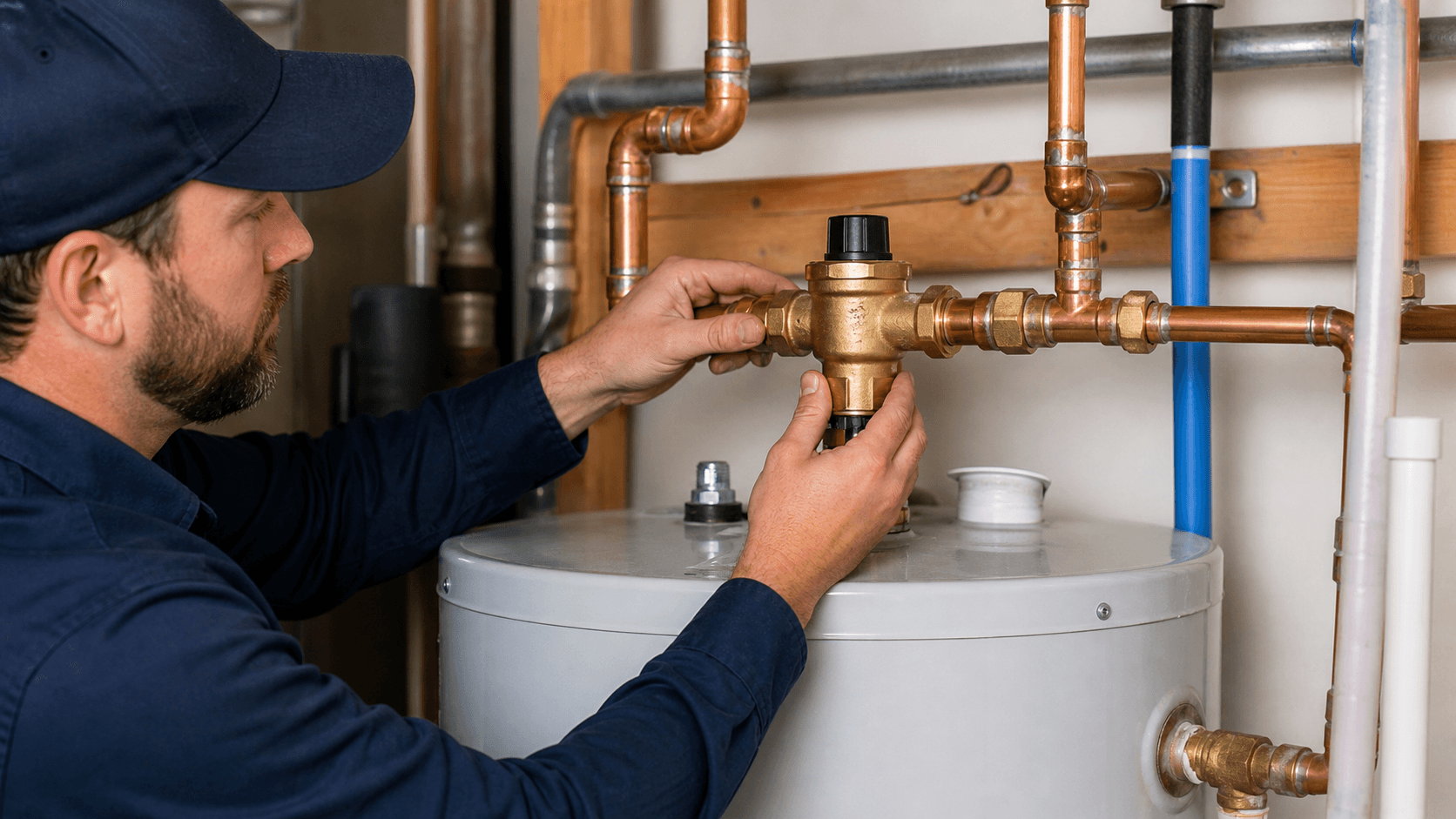
A thermostatic mixing valve blends hot tank water with cold to deliver about 120°F at the tap while the tank stores at 140°F, giving Legionella control without the scald risk.
A thermostatic mixing valve is a temperature-regulating valve installed downstream of the water heater that automatically blends scalding tank water with cold supply to hold the delivered temperature near a setpoint. Installed on the hot outlet, it lets the tank store at 140°F — hot enough to kill Legionella — while the water reaching the fixtures is tempered back to about 120°F, safe to touch. The valve resolves the opposed-hazard problem directly: the bacteria see the storage temperature, and the household sees the delivery temperature.
OSHA's guidance for managing Legionella reflects exactly this layered approach — store at or above 140°F and deliver at or above 122°F, using a thermostatic mixing valve near the outlets to manage the scald risk that the high storage temperature would otherwise create. The mixing valve is what makes a hot-storage strategy compatible with everyday safety, and it is the standard engineering answer when a building has both a Legionella concern and occupants who must not be exposed to 140°F water.
The household profile decides the setting. A home with immunocompromised occupants who face a real Legionella concern is the case for 140°F storage plus a mixing valve; a home with young children or older adults and no special Legionella risk is the case for a straightforward 120°F setting where scald protection comes first and no mixing valve is needed. A mixing-valve installation is plumbing work — tying into the hot outlet and setting the blend — and is best booked through water heater repair and installation in Bellevue rather than attempted as a casual DIY job.
Turn the thermostat to 120°F, run a hot tap for two minutes, and verify the temperature at the tap with a thermometer.
The control differs by fuel type. On a gas unit, the temperature dial is on the face of the gas control valve near the base of the tank, usually marked with relative settings rather than exact degrees, so the dial gets you close and the verification step confirms the actual number. On an electric unit, the thermostats sit behind the access panels and must be set with the breaker off; critically, set both the upper and lower thermostats to match, because a mismatch leaves one stage fighting the other and the delivered temperature unpredictable.
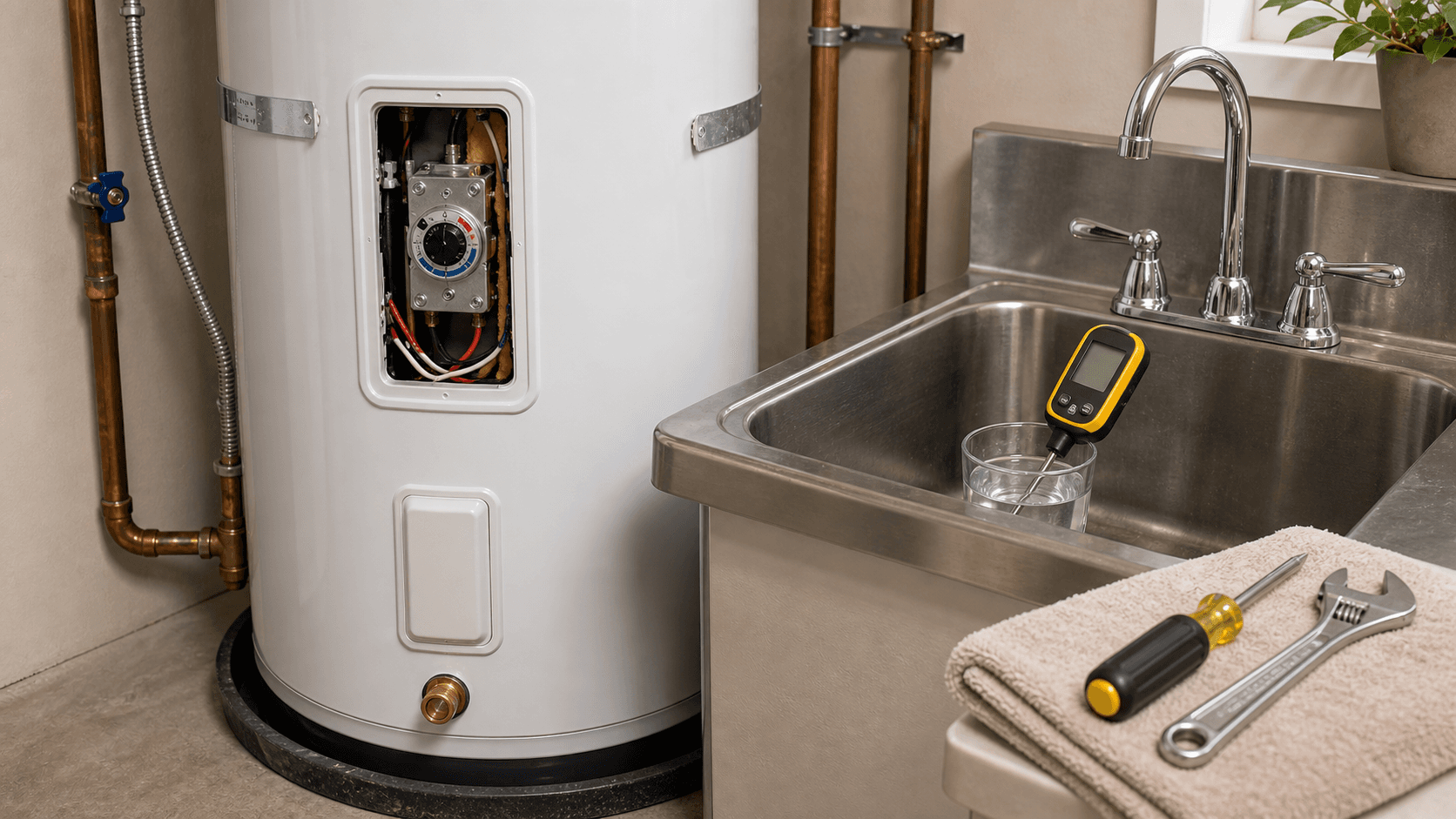
Verify rather than trust the dial. After adjusting, allow the tank a few hours to stabilize at the new setting, then run a hot tap for about two minutes to clear the cooled water sitting in the lines and catch the true tank temperature in a cup at the fixture, measured with a kitchen or candy thermometer. Adjust and re-check until the tap reads near 120°F, since the dial markings and the actual output often differ by several degrees, especially on gas units with relative-only labels.
The 120°F target pays a maintenance dividend beyond safety and energy. A moderate storage temperature slows the mineral deposition and corrosion that drive sediment buildup and tank wear, so it helps the many aging Eastside tanks reach the upper end of their service life rather than being cooked toward an early failure at 140°F. The full lifespan picture, including how the temperature setting ranks against the anode rod and water hardness as a lever, is in our how long water heaters last guide, and the corrosion-and-sediment mechanism is in water heater making noise.
Yes — 120°F is safe for kids and seniors: water takes about 5 minutes to cause a third-degree burn at 120°F, versus roughly 5 seconds at 140°F.
Yes — 120°F is the safe setting for households with young children and older adults, and the scald-time numbers are why. Water at 140°F causes a third-degree burn in about 5 seconds, water at 130°F in about 30 seconds, and water at 120°F takes roughly 5 minutes of contact to reach the same injury — a sixtyfold difference in exposure tolerance between 140°F and 120°F. That margin matters most for children, whose skin is thinner and burns faster than an adult's per the U.S. Consumer Product Safety Commission, and for older adults with slower reaction times, because at 120°F an accidental hot stream gives minutes to react where 140°F gives seconds. Both the CPSC and the U.S. Department of Energy converge on 120°F as the default residential setting, and a home should only store hotter when a documented Legionella concern justifies it — and then with a thermostatic mixing valve to keep the delivered water back near the safe 120°F at the tap.
Every fact in this guide cites a verifiable public source. If you find a number we got wrong, email dispatch@bellevueplumberpro.com.
Need help with this in your home? See our Water heater repair and installation in Bellevue page for pricing, our diagnostic process, and how same-day service works across the Eastside.
Related services: Leak Detection and Pipe Repair.
120°F — the temperature the U.S. Department of Energy recommends to balance scald safety and energy cost.
They trade different hazards: 120°F is safer for scald risk, while 140°F is safer against Legionella, which dies within about 2 minutes at 140°F and grows between 77°F and 113°F.
Homes with immunocompromised occupants, where Legionella control matters most — ideally with a thermostatic mixing valve so taps still deliver safe temperatures. Homes with young children or older adults should stay at 120°F for scald protection.