How long does a water heater last?
A storage tank water heater lasts 8 to 12 years — up to about 15 with good maintenance. A tankless unit lasts 20+ years, roughly double, because it has no standing reservoir of water in constant contact with steel.
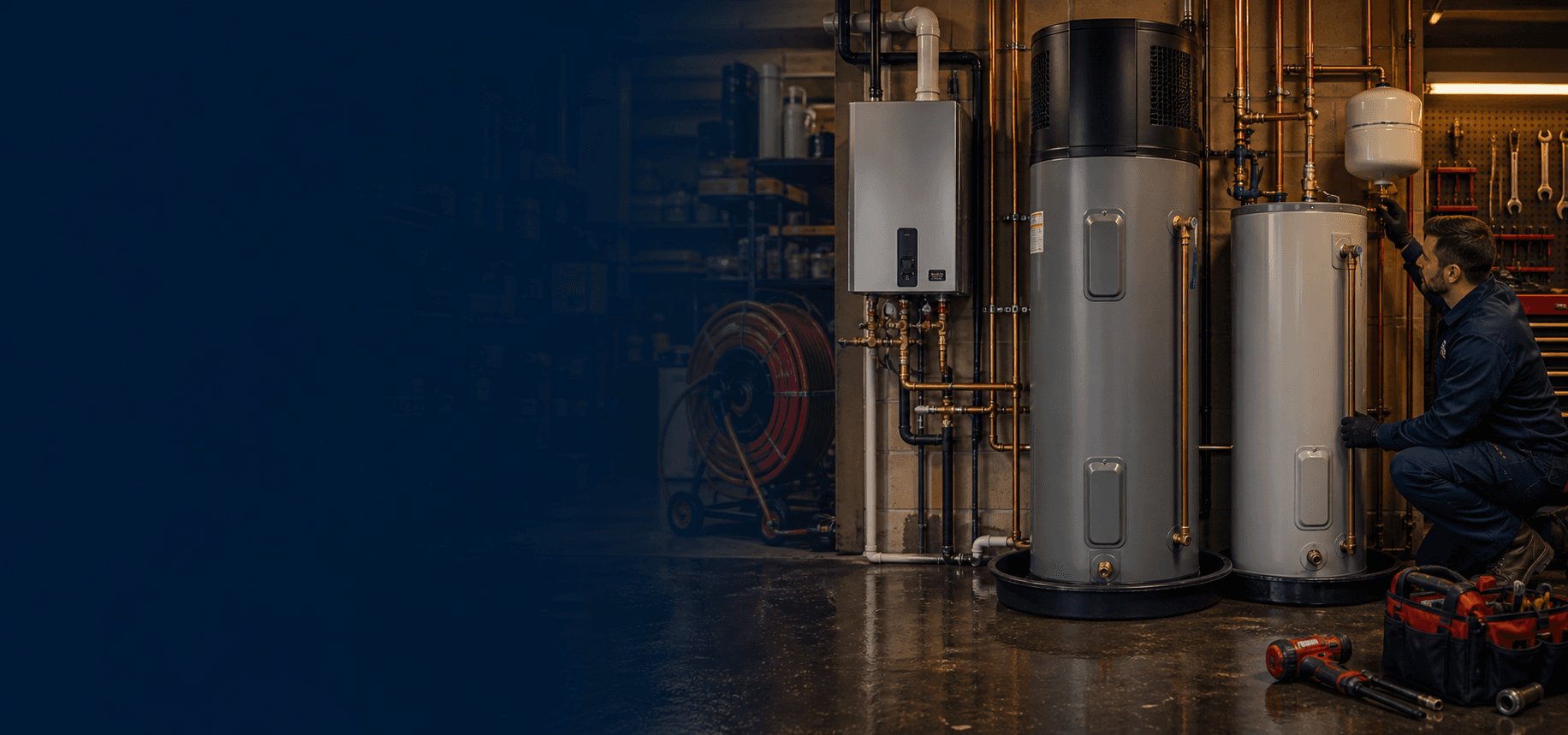
Water heaters last about 8 to 12 years for storage tanks and 20+ years for tankless units, and the sacrificial anode rod plus water hardness are the two biggest levers on that lifespan. The spread between a tank that dies at 8 years and one that reaches 15 is almost entirely maintenance and water chemistry, both of which a homeowner controls. This guide explains why the anode rod determines tank life, how soft versus hard water changes the timeline, what maintenance extends it, and where the repair-vs-replace line falls. It also covers the Eastside-specific advantage — soft Cedar- and Tolt-sourced water pushes a well-maintained Bellevue tank toward the upper end of the range — and how to read the manufacture date off the rating sticker so you know your unit's true age before deciding to repair or replace.
Last reviewed: 2026-06-04
A storage tank water heater lasts 8 to 12 years — up to about 15 with good maintenance — and a tankless water heater lasts 20+ years.
A conventional storage tank water heater lasts 8 to 12 years as a baseline, and up to about 15 with consistent maintenance and favorable water chemistry. A tankless water heater lasts 20+ years — roughly double — for a structural reason: it has no standing reservoir of water in constant contact with steel, so the corrosion that ends a tank's life never gets the same foothold. Tankless units heat water on demand as it passes through a heat exchanger, eliminating the corroding pressure vessel entirely.
For storage tanks, the eight-year low and the fifteen-year high are not luck — they are the difference between a tank left alone and a tank maintained. The variables that decide where a given unit lands are the condition of the sacrificial anode rod, the hardness of the water, whether the tank is flushed, the temperature it is held at, and the quality of the original install. Each of these is a lever a homeowner can pull, which is what makes a near-doubling of service life achievable rather than fixed.
Tankless longevity comes with its own maintenance caveat worth naming. Tankless heat exchangers can scale up in hard water and need periodic descaling to reach the 20-plus-year figure, so soft Eastside water is as much an advantage for a tankless unit as for a tank. The tank-versus-tankless trade-off — upfront cost, capacity, and lifespan together — is laid out in our tankless vs storage water heaters in Bellevue guide, and a heat-pump option is weighed in heat pump water heaters in Bellevue.
This happening in your home right now? A licensed plumber can talk you through the next step on the phone — 24/7, and the call is free.
Call a plumberA tankless water heater lasts 20+ years — roughly double a storage tank — because it has no standing reservoir of water in constant contact with steel for corrosion to attack.
Rheem puts tankless lifespan at 20+ years, against the 8-to-12-year baseline of a storage tank, and the reason is structural rather than a matter of build quality. A tankless unit heats water on demand as it passes through a heat exchanger, so there is no standing reservoir of hot water sitting against a steel pressure vessel year-round. The corrosion that ends a storage tank's life — sediment plus a depleting anode rod eating through the wall — never gets the same foothold when there is no tank to corrode, which is what nearly doubles the service life.
The 20-plus-year figure is not automatic, though; it depends on descaling. Tankless heat exchangers can scale up in hard water, and reaching the full lifespan requires periodic descaling to clear mineral buildup from the exchanger passages. This is where soft Eastside water is as much an advantage for a tankless unit as it is for a tank — Bellevue's Cedar- and Tolt-sourced supply deposits far less scale, so the descaling burden is lighter and the path to the upper end of the range is easier than in a hard-water market.
The longer life is one input to the tank-versus-tankless decision, not the whole of it. Upfront cost, gas-line capacity, and capacity behavior under simultaneous draws all weigh alongside lifespan, and the full trade-off is laid out in our tankless vs storage water heaters in Bellevue guide; a heat-pump alternative is weighed in heat pump water heaters in Bellevue. When the choice is made, installation and sizing are booked through water heater repair and installation in Bellevue.
The anode rod is a sacrificial metal that corrodes in place of the steel tank, and the tank begins to rust once the rod is depleted.
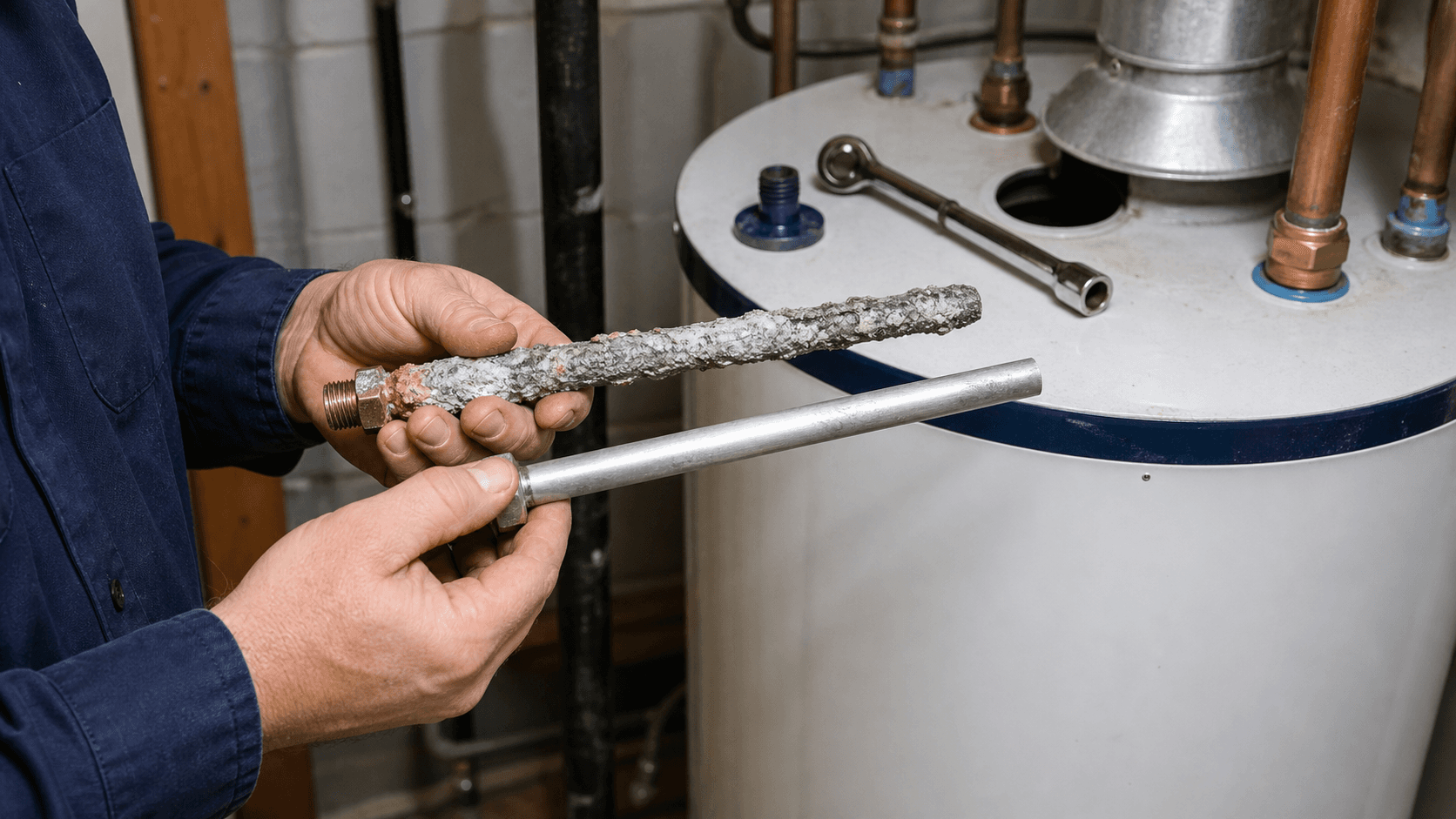
The anode rod is a length of magnesium or aluminum threaded into the top of the tank that protects the steel by galvanic sacrifice: it is more reactive than the tank's steel, so the corrosive electrochemistry attacks the rod preferentially and the steel stays intact. The rod is deliberately consumed in the tank's place — that is its entire job — and as long as enough rod remains, the steel is shielded. This single component is why a steel tank full of water for a decade does not simply rust through in a year or two.
The corner the homeowner has to watch is the moment the rod runs out. Once the anode is fully depleted, the protection disappears and the corrosion that was eating the rod turns to the bare steel of the tank, which then begins to rust from the inside. A tank discovered leaking from the bottom is very often a tank whose anode was used up years earlier and went unreplaced — the depletion is the hidden first failure, and the visible leak is the delayed consequence.
Replacing the anode rod before it is fully consumed is therefore the single most effective way to extend tank life, and it is dramatically cheaper than the replacement it forestalls. The rod should be inspected every 3 to 5 years and swapped when it is heavily worn, which can add years to a tank for the cost of a part. Our anode rod replacement in Bellevue guide covers how to check the rod and change it, and the same inspection pairs naturally with the annual flush.
Hard water shortens a water heater's life through scale and sediment, and soft water is gentler on the tank.
Hard water shortens tank life through the calcium and magnesium it carries. Those minerals drop out of solution as the water heats and accumulate as scale on the heating surfaces and as sediment on the tank floor, where the buildup insulates the heat source, overheats and stresses the steel, and forces the unit to work harder for the same output. The harder the water, the faster that buildup forms and the more it accelerates the wear that ends a tank's life, which is why hard-water markets sit at the low end of the lifespan range.
Soft water is gentler on every count, and this is a real Eastside advantage. Bellevue's supply, drawn from the Cedar and Tolt watersheds, is soft and leaves far less scale and sediment than hard-water markets, so a well-maintained Bellevue tank faces less of the mineral-driven wear and can push toward the upper end of 12 to 15 years. The same softness is why an Eastside tank needs flushing only once a year rather than twice, a maintenance saving that compounds over the life of the unit.
Soft water reduces but does not eliminate the need to maintain, which is the part homeowners sometimes misread. Even soft water deposits some sediment over a decade, and the anode rod still depletes on its own schedule regardless of hardness, so the Eastside advantage rewards an owner who keeps up the basic maintenance rather than excusing them from it. Our Eastside water hardness guide covers the local water chemistry in depth, including how soft the supply actually is and what that means across the home's plumbing.
Annual flushing, anode-rod replacement, a moderate 120°F temperature setting, and a correct install extend water-heater life by years.
Ranked by impact, the levers on tank life are the anode rod first, water hardness second, annual flushing third, the temperature setting fourth, and install quality fifth. The anode and the hardness set the corrosion baseline, flushing keeps sediment from compounding it, the temperature setting governs how aggressively the tank corrodes day to day, and the install determines whether the tank survives the thermal and seismic stresses of its environment. A homeowner who attends to the first four — and gets the fifth right at purchase — captures most of the achievable lifespan.
Two of these levers each have their own guide. A moderate 120°F setting slows the mineral deposition and corrosion that age the tank, and the full reasoning is in water heater temperature setting; the annual flush that clears sediment before it overheats the steel is covered step by step in water heater making noise. Pairing the flush with the anode-rod inspection every few years folds the two highest-impact maintenance tasks into one session.
A correct install is the lever that protects the tank from its surroundings. In Washington that means two-strap seismic bracing — the tank strapped in its upper and lower thirds and anchored into studs — so an earthquake cannot tear the tank off its gas and water connections, plus a thermal-expansion tank on any closed system to absorb the pressure spikes of each heating cycle instead of stressing the tank and the T&P valve. Both are code-required on a compliant Bellevue install and both directly extend service life by removing thermal and pressure stress the tank would otherwise absorb.
Replace a water heater over 10 to 12 years old when the tank itself leaks, and repair newer units with a single part failure.
The cleanest dividing line combines age with the nature of the failure. A tank past 10 to 12 years old that is leaking from the tank itself is at end of life and gets replaced, because the steel pressure vessel has corroded through and no repair returns it to safe service. Pouring repair money into a perforating tank of that age buys little, since the next failure point on a corroded tank is rarely far behind the first.
A newer unit with a single discrete part failure is the opposite case and is worth repairing. A failed drain valve, a chattering T&P valve, or a burned-out heating element are all cheap part swaps on an otherwise sound tank with years of life left, and replacing the whole unit over one fitting wastes the remaining service life. The trick is telling a fitting leak from a tank failure, which our water heater leaking from the bottom guide walks through with the paper-towel test.
When the call is replacement, the Eastside numbers and rules apply: a storage replacement runs about $1,700 to $2,500 installed and requires a City of Bellevue plumbing permit, with two-strap seismic bracing and a closed-system expansion tank brought up to current code as part of the work. That permit-and-code requirement is also a reason to use a licensed installer rather than a like-for-like swap, and you can weigh options and book through water heater repair and installation in Bellevue.
Read the manufacture date encoded in the serial number on the rating sticker to learn the unit's true age.
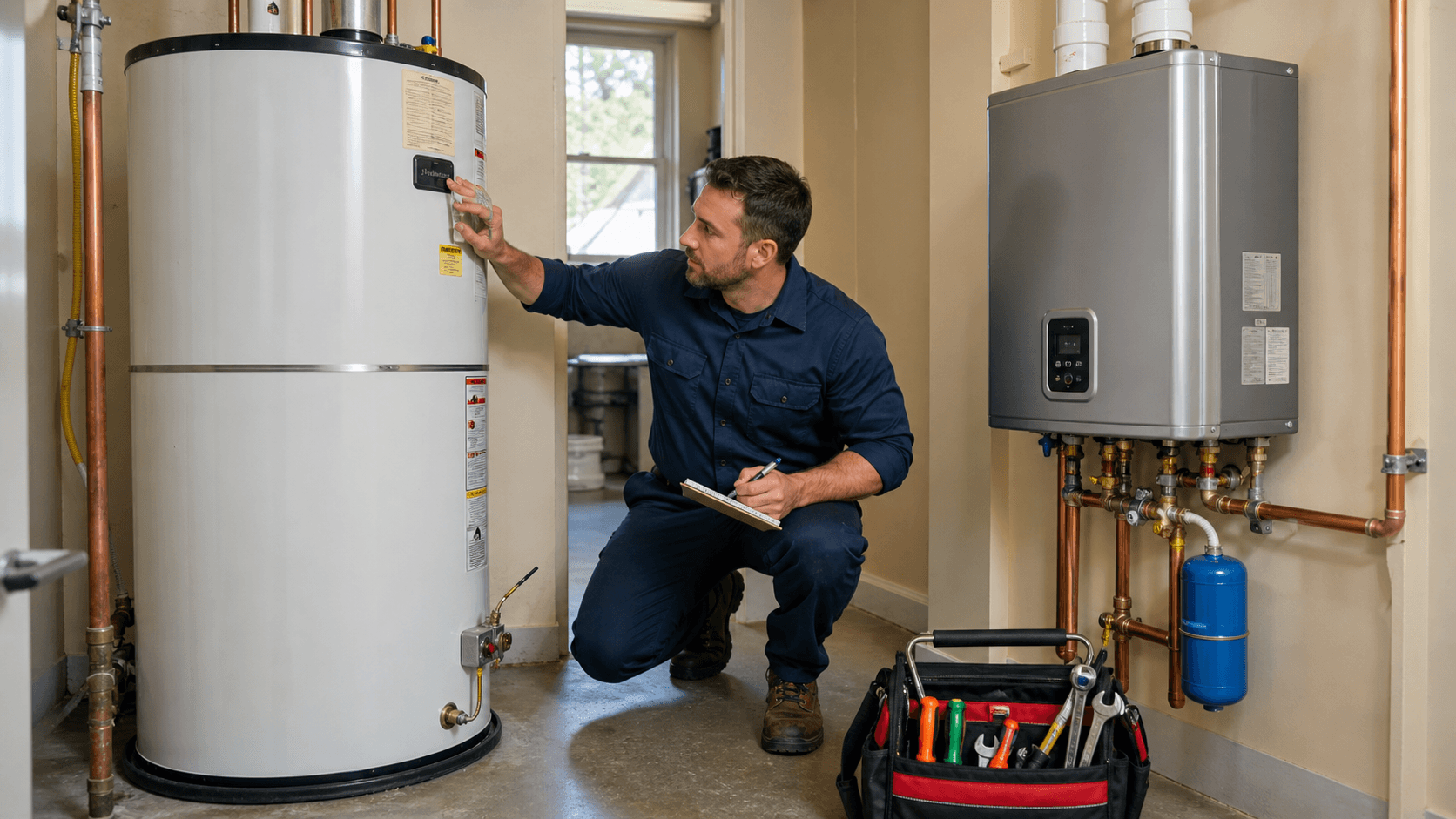
The rating sticker — the printed label on the side of the tank listing model and serial numbers, capacity, and ratings — carries the unit's manufacture date, usually encoded in the serial number rather than stated outright. Decoding it gives the tank's true age, which is the fact that drives the repair-or-replace decision, since a leak on an 11-year-old tank means something very different than the same leak on a 4-year-old one.
Serial-number formats vary by manufacturer, so the date is read against the specific brand's decoding key: many brands encode the year and week or month in the first few characters of the serial, but the scheme differs enough that a guess is unreliable. Where the serial is illegible or the brand's key is unclear, a quick professional inspection settles both the age and — by pulling the anode and looking at the tank — the actual condition behind the sticker's date.
Confirming the date matters most in Bellevue's older housing stock, where many original 1960s–80s tanks are already at or well past end of life today. A homeowner who reads the sticker before authorizing a repair avoids sinking money into a tank that the date alone says is finished, and instead moves a genuinely aged unit straight to the replacement and code-upgrade path described above.
Yes — soft Eastside water pushes a well-maintained tank toward 12 to 15 years. And yes, replacing the anode rod pays off: it corrodes in place of the tank.
Yes — soft water makes water heaters last longer. Hard water shortens tank life through the calcium and magnesium it carries, which drop out as scale and sediment that insulate the heat source, overheat the steel, and accelerate the wear that ends a tank's life. Bellevue's Cedar- and Tolt-sourced supply is soft and leaves far less of that buildup, so a well-maintained Eastside tank faces less mineral-driven wear and can push toward the upper end of about 12 to 15 years rather than the 8-year low. The softness is also why an Eastside tank needs flushing only once a year instead of twice — a maintenance saving that compounds over the life of the unit. Even soft water deposits some sediment over a decade, so the advantage rewards an owner who keeps up the basic maintenance rather than excusing them from it; the local water chemistry is detailed in our Eastside water hardness guide.
Yes — replacing the anode rod is worth it, and it is the single most effective and cheapest way to extend tank life. The anode is a sacrificial rod that corrodes in place of the steel tank, so as long as enough rod remains, the steel stays protected; once the rod is fully consumed, the corrosion turns to the bare tank and it begins to rust from the inside. Inspecting the rod every 3 to 5 years and swapping it before it runs out can add years to a tank for the cost of a part, dramatically cheaper than the $1,700-to-$2,500 replacement it forestalls. A tank found leaking from the bottom is very often one whose anode was used up years earlier and went unreplaced — which is exactly why our anode rod replacement in Bellevue guide treats it as the highest-impact maintenance task on the unit.
Every fact in this guide cites a verifiable public source. If you find a number we got wrong, email dispatch@bellevueplumberpro.com.
Need help with this in your home? See our Water heater repair and installation in Bellevue page for pricing, our diagnostic process, and how same-day service works across the Eastside.
Related services: Leak Detection and Pipe Repair.
A storage tank water heater lasts 8 to 12 years — up to about 15 with good maintenance. A tankless unit lasts 20+ years, roughly double, because it has no standing reservoir of water in constant contact with steel.
A depleted anode rod — the sacrificial metal that corrodes in place of the tank — and hard-water scale. The tank begins rusting once the rod is spent; soft water is gentler on the tank.